
Harlingen Previous Residents by Era
A backward address search begins with a modern Cameron Appraisal District parcel record, but the evidence changes as the date moves back. The Cameron County Clerk current index supplies recent recorded instruments. Its historic Kofile index supplies a separate book-based route. Directories, newspaper scans, census schedules, maps, probate material, and county microfilm can add the household and place context that a transfer record lacks. Keep the address, parcel account, legal description, document number, and source date together. That makes it possible to separate a similarly named tract from the Harlingen address being studied.
| Source | Years It Covers | Where Held | What It Shows |
|---|---|---|---|
| Current official-record index | Live portal, current coverage varies | Cameron County Clerk | Recorded deeds, plats, liens, and related instruments |
| Historic Cameron deed index | 1830–1968; linked documents 1830–1957 | Kofile / Cameron County | Grantor, grantee, year, historic book references, and linked records where present |
| County deed and tax microfilm | Deeds 1848–1885; deed index 1848–1911; tax rolls 1848–1910 | TSLAC guide and UTRGV depository | Early transfers, index direction, taxpayer, land, and record-volume leads |
| Harlingen directories | Located years from 1939 through 1960, with gaps | Library and digitized collection routes | Name, address, telephone, spouse, and other printed entry details |
| Federal census and local newspapers | Census 1790–1950 public; Valley Morning Star listed 1901–1995 | NARA, library databases, and Harlingen Public Library | Household context, announcements, obituaries, and street references |
Use the record closest to the question’s date first. A recent address question normally starts with CAD and the Clerk. An early tract question may require microfilm before any city directory exists. A mid-century household question is better tested against a dated directory issue and newspaper image than against a tax-roll name alone.
Harlingen Previous Residents Deed Indexes
The County Clerk’s current public-access route now points researchers to the Tyler official-records portal, which offers Quick Search, Advanced Search, recorded-date ranges, index-only searching, OCR searching, property alerts, cart, and account functions. The historic Kofile interface has a different purpose and a book-and-volume logic. It covers 1830–1968, with linked historic documents stated for 1830–1957. Treat those dates as the index’s published coverage claim, not proof that every image is online or legible.
At the historic Cameron County deed index, the captured interface shows controls for document type, year, party names, book, volume, and page. Search one transfer at a time. When a result supplies only a name, compare the legal description and recording data before adding it to a chain. The current Clerk portal is useful for later instruments, while Kofile can carry the trail into the historic books.
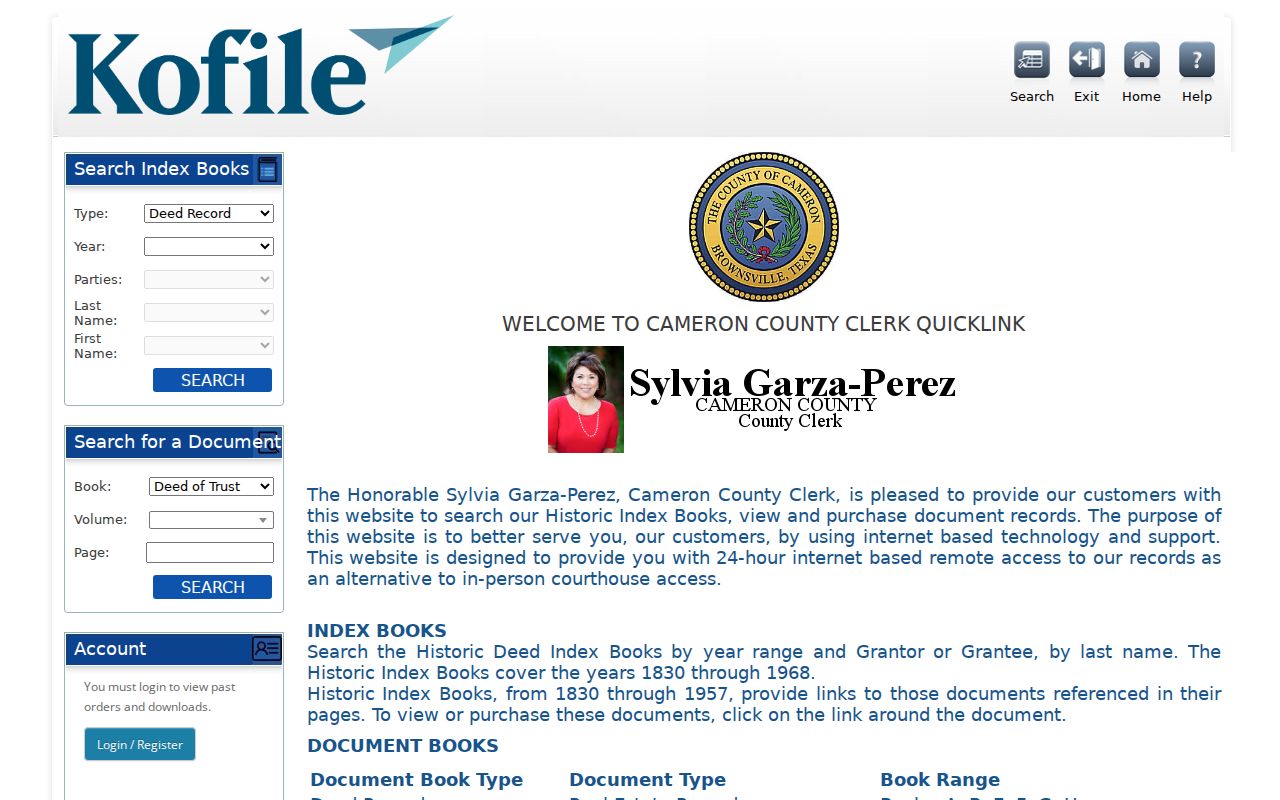
The historic index screenshot shows why a party name alone is not enough. Its year and book controls provide a way to narrow the result before moving to a linked document, original volume, or certified-copy route.
Note: The live Tyler interface and the historic Kofile interface can change, so record the portal, search mode, and access date with each result.
Harlingen Previous Residents Map Clues
For house history, the four-sheet June 1919 Sanborn map is a dated snapshot of street layout, building footprints, uses, construction materials, and railroad or public-building context. It does not identify occupants or establish a current street number. Pair the map with an address section from a directory and a newspaper scan, using the same historic street spelling and a nearby cross street when possible. That combination can explain why an older item does not resemble a modern parcel description.
The Library of Congress Harlingen Sanborn record provides public access to the 1919 map. The Harlingen Public Library digital newspaper archive supports people, places, events, city, title, and date searching. OCR can miss accents, hyphens, house numbers, and surnames, so the scanned page remains the source to read and cite.
A map-plus-newspaper result supports a historical reconstruction, not a claim that someone occupies the address now. For an address that changes form across time, retain both the old label and the current official spelling in the research notes.
Trace Harlingen Previous Resident Deeds
Previous residents and past owners are different questions, but the title chain gives the most reliable sequence for the property itself. CAD is the start because it ties the current situs address to a parcel account and legal description. The Clerk’s index then supplies the recorded instrument trail. Old deeds may omit a street address, so match lot, block, subdivision, survey, or other legal-description terms before treating a name hit as the same tract.
- Find the current situs address in the Cameron Appraisal District property-search route and note the account, subdivision, lot or block, legal description, and owner-of-record entry.
- Search the current owner as grantee in the Clerk’s current official-records index. Check the recorded date, document number or book-page reference, and legal description.
- Read the matching transfer. The grantor is the party conveying an interest, and the grantee is the party receiving it.
- Search that prior party as grantee in an earlier period. Repeat only when the legal description and timing still match the same parcel.
- When the record moves beyond the current portal, use Kofile, then the Clerk or the microfilm route for an unlinked book, image, or earlier volume.
- Chain of title
- The sequence of recorded transfers and related instruments that connect interests in the same tract over time.
- Legal description
- The lot, block, subdivision, survey, or other land description used to identify property in a recorded instrument. It is often more stable than an old street address.
- Grantor / grantee
- The grantor conveys an interest; the grantee receives it. Either name needs confirmation against the described tract.
- Deed of trust
- A financing instrument. It can date a loan relationship, but by itself it does not prove a sale.
Harlingen Previous Residents Address Gaps
Older records may use a highway variant, rural route, former street spelling, or a tract description rather than today’s number. Harlingen’s 2023 annexation map lists annexation years beginning in 1910 and extending through 2021–23, plus several disannexation years. The city charter traces the 1927 charter and later boundary changes. County records, a printed directory, and a current city map can therefore describe the same area through different civic labels.
There is also a real archival gap. TSLAC reports that deed-record volumes C and D, covering August 14, 1850 through February 6, 1851, were destroyed in an 1854 fire. No search result from that interval should be read as proof that no transaction occurred. Use later deeds, tax records, probate, court material, or newspaper evidence to bridge the gap.
Note: When an address search fails, preserve the street variant and legal description instead of forcing an old record into today’s numbering system.
Harlingen Previous Residents Directory Pairing
The property chain does not identify every past household. Harlingen city-directory issues located for 1939, 1941–44, 1946, 1948, 1950, 1952, 1954, 1956–57, and 1959–60 can add a dated address listing. The run has meaningful missing years, including 1940, 1945, 1947, and 1949 in one reel listing. Absence from a missing issue is not evidence about who lived there before. The historical volumes themselves are described in the Harlingen City Directories.
Pair each issue with the nearest public census snapshot. The 1950 census is the latest publicly available decennial census in 2026. A directory may reflect information gathered in the preceding year, so cite the issue year and, where possible, the printed page. A name at an address can be tested against spouse notation, initials, neighborhood context, and the census enumeration geography.
- Record the directory year, page, spelling, address form, and whether the entry is residential or business-related.
- Check the nearest available directory issue, without inventing an entry for a known missing year.
- Compare the address with the nearest census and retain the census year separately from the directory year.
- Search the Valley Morning Star archive for an obituary, move notice, club mention, or other dated address clue, then inspect the scan.
Harlingen Previous Residents in Microfilm
When the online trail stops, the Texas State Library and Archives Commission guide is the concrete fallback. Its Cameron County listing includes deed records for 1848–1885, deed-record indexes for 1848–1911, direct and reverse deed-of-trust indexes, probate minutes from 1848–1912, naturalization material, and tax rolls from 1848–1910. Copy the reel number, volume, date range, and index direction before requesting material. A reverse index can be essential when a chain stops in the forward sequence.
The TSLAC Cameron County microfilm holdings are a guide to the records path, not a substitute for an original page. TSLAC says no more than five reels may be borrowed at a time, loans are generally for 14 days with a possible 14-day extension, and use is in-library. Staff can hold five reels for one week for an on-site visit but do not search them for a patron. Certified copies remain a Clerk or District Clerk matter.
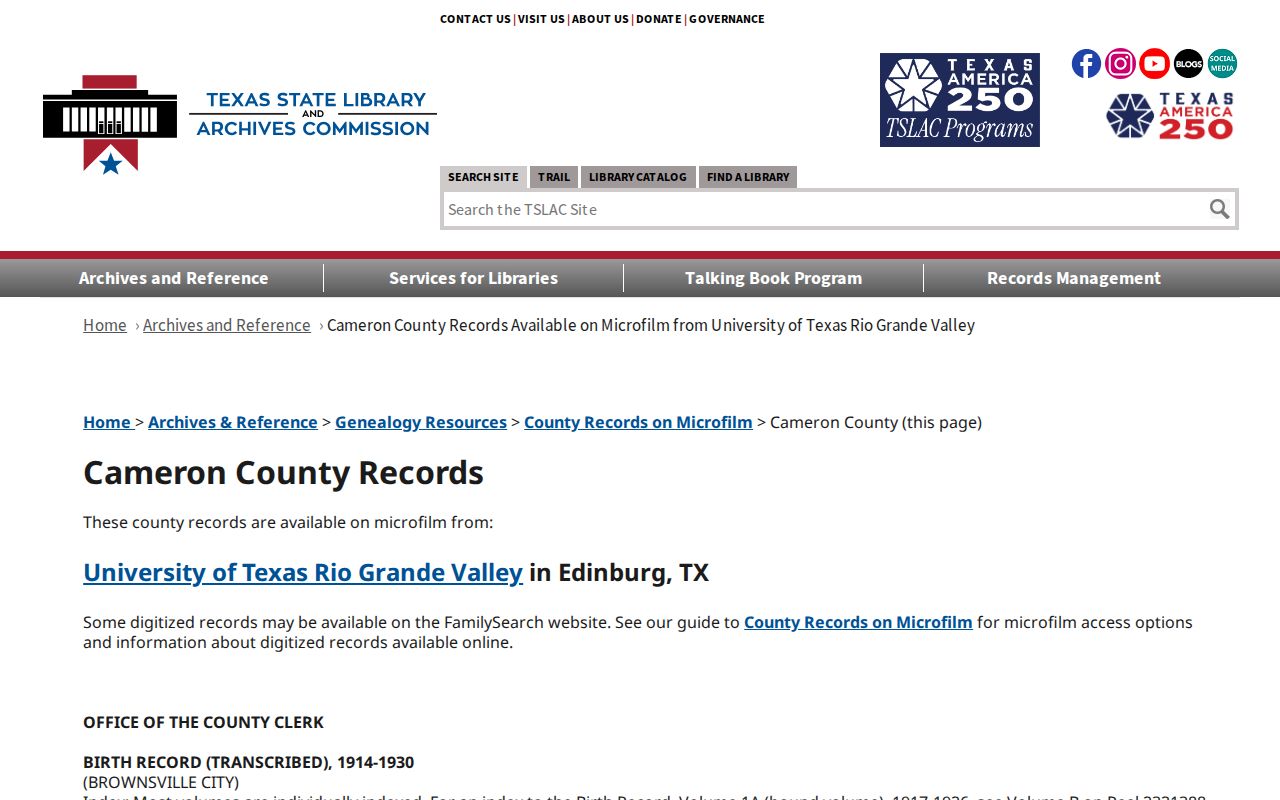
The holdings list makes the offline route reproducible. It tells a researcher which record family and time span to request when a portal result points only to an older book or unlinked index entry.
Harlingen Past Residents Estate Endpoints
A trail can end with a move, death, estate transfer, trustee, corporate owner, or an unresolved older description. Probate minutes can identify an estate, executor, heirs, mailing address, or property reference, but they do not prove a current residence. Obituaries and cemetery evidence can provide a date and family context. They need their own source citation because an obituary is not a deed and a cemetery marker is not a title record.
The Harlingen Cemetery marker history provides a local cross-check: it identifies a first burial in 1909, legal establishment in 1912, and city ownership from 1947. Use that history with a dated newspaper item and a Clerk record where the question is genealogical. Do not turn an endpoint source into a list of living people or expose a protected address.
Harlingen Previous Residents Preservation Watch
Harlingen Arts & Heritage Museum received a FY2026 IMLS award of $19,632 for digital asset management and digitization of historical photographs, documents, and ephemera. The award creates a promising route for house and neighborhood context, but it does not mean a public name or address index already exists. Ask the museum which materials are cataloged, public, or still being processed before treating an archival gap as a negative result.
The FY2026 IMLS award record identifies the digitization work. The museum and County Clerk restoration efforts show why historic research needs dated citations: a scan, OCR result, catalog entry, or portal label may become available later without changing the underlying record’s original date.