
Harlingen City Directory Collections
The strongest located Harlingen city directory run belongs to a wider library, digitized-collection, and microform network rather than to a city-government shelf. The Allen County Public Library listing, FamilySearch Library references, and digitized U.S. city-directory collections identify individual Harlingen volumes from 1939 into 1960. Verify the title page and image for every citation. Later microfilm can combine Harlingen with San Benito, and a catalog record can preserve a misspelling.
| Collection or run | Years located | Where held | Access route |
|---|---|---|---|
| Harlingen directories in the ACPL listing | 1939; 1941–1944; 1946; 1948; 1950; 1952; 1954; 1956–1957; 1959–1960 | Allen County Public Library directory collection | Catalog or collection route; one listing spells the place “Haringen” |
| Harlingen City Directory aggregate | 1939–1956 | FamilySearch Library and digitized U.S. city-directory collections | Search available images by year, then verify the image and page |
| Individually located digitized volumes | 1939, 1941, 1942, 1944, 1946, 1948, 1950, 1952, 1954, 1956 | Ancestry U.S. City Directories | Subscription or library-provided access |
| Second image listings | 1950 and 1959 | MyHeritage listings | Use as a second image check, not as a replacement for a page citation |
| Texas city-directory research collections | City-specific, late nineteenth century to present | TSLAC, Briscoe Center, Portal to Texas History, and library databases | Print and microform routes can require on-site or library access |
The collection record establishes that an edition was located. It does not prove every Harlingen person was printed in it. A name may appear in the residential section, a business section, an advertisement, or a street-order section. Record which one supplied the result.
Harlingen City Directory Gaps
The gaps in the known run are part of the evidence. The ACPL reel index puts Harlingen 1939–1950 on reel 15, with 1940, 1945, 1947, and 1949 missing. It puts 1952–1959/60 on reel 16, with 1953, 1955, and 1958 missing. Other located lists also leave several intervening years absent. Do not fill a gap by assuming a household stayed put or that no volume was ever made.
Use the nearest available directory edition as a bookend, then look for a dated newspaper item, recorded deed, tax record, census page, or probate reference during the missing interval. A directory can reflect information collected before its cover year, so the title page, publisher note, and source date deserve a place in the citation. The 1950 census is the latest public federal decennial census as of 2026; it can help frame a directory interval but should not replace the volume itself.
Note: A missing Harlingen directory year is a collection gap, not proof that a person or address was absent from the city.
Reading Harlingen City Directory Entries
A Harlingen city directory entry has to be read as a line in a historical publication, not as a modern database result. The located sources identify common fields but did not expose a stable, text-readable sample page without a collection login. Open the page image and the volume's abbreviation key before interpreting any shorthand. Keep the original spelling, punctuation, initials, and page number, especially for compound Hispanic surnames or a name that appears more than once.
| Name line | Surname, given name, or initials in the alphabetical residential section, sometimes with a spouse or relationship notation. |
|---|---|
| Address line | Street address, apartment or room reference, rural route, or another place clue printed in that edition. |
| Business line | A business, employer, or work description where the publisher included one. Read the abbreviation key before expanding it. |
| Telephone | A number or exchange where printed; it is a historical contact detail, not present contact information. |
| Residence-status mark | An ownership or occupancy-style mark where that volume uses one. Its exact meaning must come from that volume's key. |
| Separate listing | A business, institutional, advertisement, or reverse/street section that may not duplicate the residential line. |
- Criss-cross directory
- A street-order portion of a directory that can place listings by address rather than surname when the volume includes it.
- Householder index
- A name-centered arrangement that points to a household listing, but may not include every person associated with an address.
- Abbreviation key
- The publisher's explanation of shorthand, usually near the front of the volume; photograph it with the entry.
Do not translate a surname, a relationship mark, or a residence-status symbol from another city or year. The digitized U.S. City Directories collection is a route for inspecting an available page image, while access conditions can vary.
Harlingen City Directory Access Routes
The Texas State Library and Archives Commission city-directory guide is the statewide access map for material that does not appear in a simple web search. It points researchers toward its own print and microform holdings, the Dolph Briscoe Center, Portal to Texas History, library editions of major genealogy databases, and WorldCat. TSLAC says its city-directory holdings may require an on-site visit and that staff do not search or transcribe the books by phone or email.
This is the right fallback when a Harlingen city directory year is known but no open image is available. Ask for the city, year, publisher if known, and reel or call number. A library edition may provide access to a digital image that is not available from a home connection. When the request involves Cameron County legal records rather than a directory image, use the county custodian instead of asking a library to certify a copy.
The TSLAC guide is shown below because it identifies the collection routes that support Harlingen city-directory research.
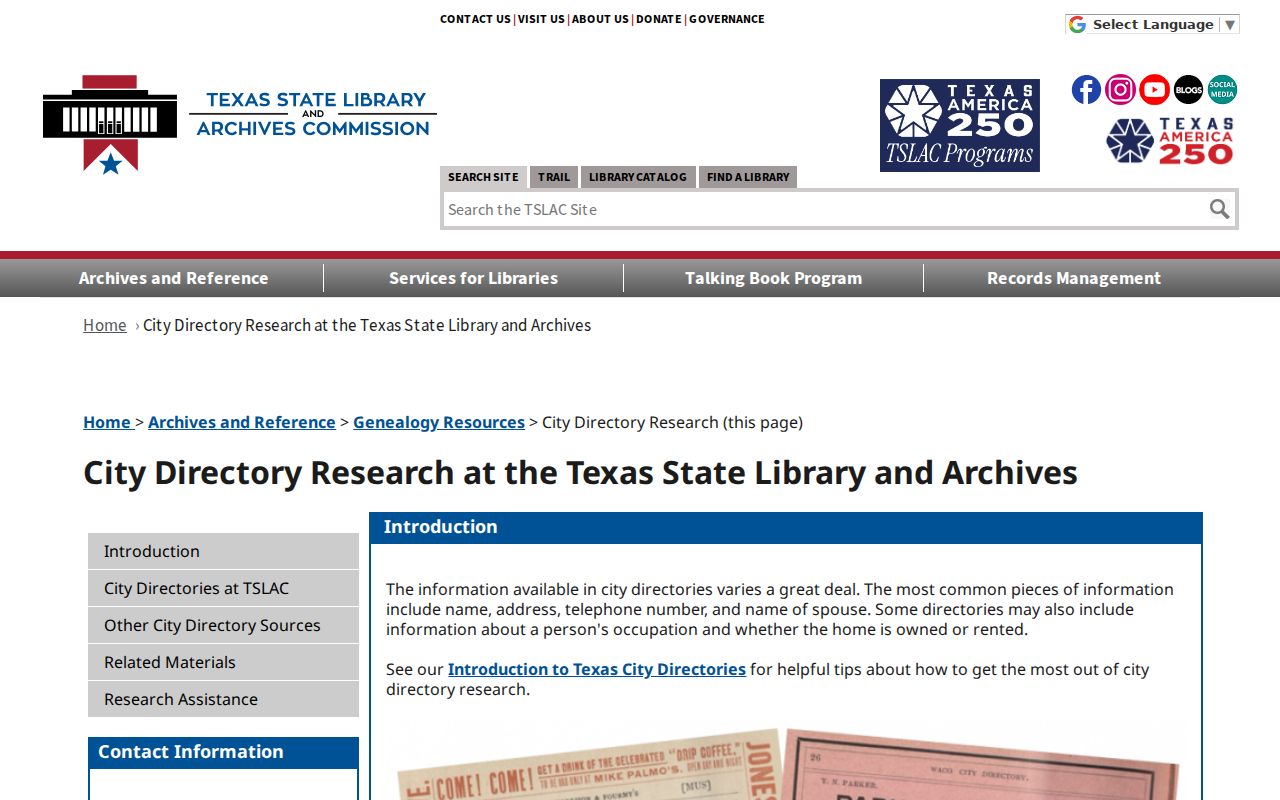
The guide helps distinguish a catalog, an on-site volume, a microform reel, and a digitized collection before time is spent chasing a broken search result.
Note: TSLAC's research guide identifies access routes, but the directory image and title page remain the evidence for a Harlingen citation.
Harlingen City Directory Newspaper Clues
The Harlingen Public Library digital newspaper archive is the best local companion to a city directory. Its Advanced Search includes page-text inputs, multiple terms, an AND connector, “Find people AND places AND events,” and country, state, city, title, and date controls. It includes leads for Valley Morning Star material from 1901–1995 and other local titles, though exact issue availability depends on the title and scan.
Search the directory name together with a street, business, spouse name, school, or nearby place. Obituary notices, marriage announcements, club rosters, advertisements, civic appointments, and move notices can explain a change between directory editions. OCR is only a discovery aid. Inspect the scanned page because accents, hyphens, initials, house numbers, and Spanish/English spellings can be misread.
This city-directory use is historical. A newspaper result can place a person or institution in a dated publication, but it does not establish a current address or present membership.
Trace Harlingen City Directories
Following one household across the Harlingen city directories works when every appearance is dated and every gap remains visible. Start with a known name, address, or newspaper date. The goal is a documented sequence, not an unbroken story. Initials, spelling variants, and a spouse's given name can separate same-name listings. A reverse section helps with an address only when the particular volume actually includes one.
- Locate the first available year and write down the year, page, publisher, exact spelling, and whether the entry is residential, business, or street-order.
- Check the nearest earlier and later available editions. Retain the documented missing years rather than interpolating a move or continuous presence.
- Compare the printed address and relationship notation with the volume's abbreviation key. If there is a reverse section, check the number in street order.
- Pair the dated directory entries with the applicable census snapshot and a local newspaper search. The 1950 census is the latest public decennial census in 2026.
- Use a deed, tax record, probate record, cemetery source, or later article only for the specific fact it can support. An address listing does not prove a property interest.
A disappearance from a volume can mean many things: a move, death, an omitted listing, a publisher change, a gap in the run, or a changed spelling. Search the next available edition, then test the date with the newspaper archive or county records before drawing a conclusion.
Note: Cite the exact Harlingen edition and page because the cover year can reflect information gathered in the prior year.
Harlingen City Directory Archive Geography
Harlingen research is spread across the Rio Grande Valley. The local library offers orientation, but regional archives and county material sit elsewhere. UTRGV Special Collections and Archives serves Brownsville and Edinburg and holds regional books, serials, manuscripts, photographs, digital collections, and finding aids. Its reading rooms are open Monday through Friday, 8 a.m. to 5 p.m., with Saturday access by appointment; appointments and videochat research assistance are recommended.
TSLAC identifies UTRGV as a Cameron County microfilm depository. The reels include deed, marriage, probate, court, naturalization, birth, death, burial-permit, cemetery, and tax materials. They can be consulted through the depository or requested through interlibrary loan, while certified copies remain the responsibility of the County Clerk or District Clerk. For a city-directory surname, UTRGV is especially helpful when the trail reaches regional history, railroad material, photographs, or a catalog-only collection.
The UTRGV Special Collections page is shown below as the regional finding-aid and reading-room route.
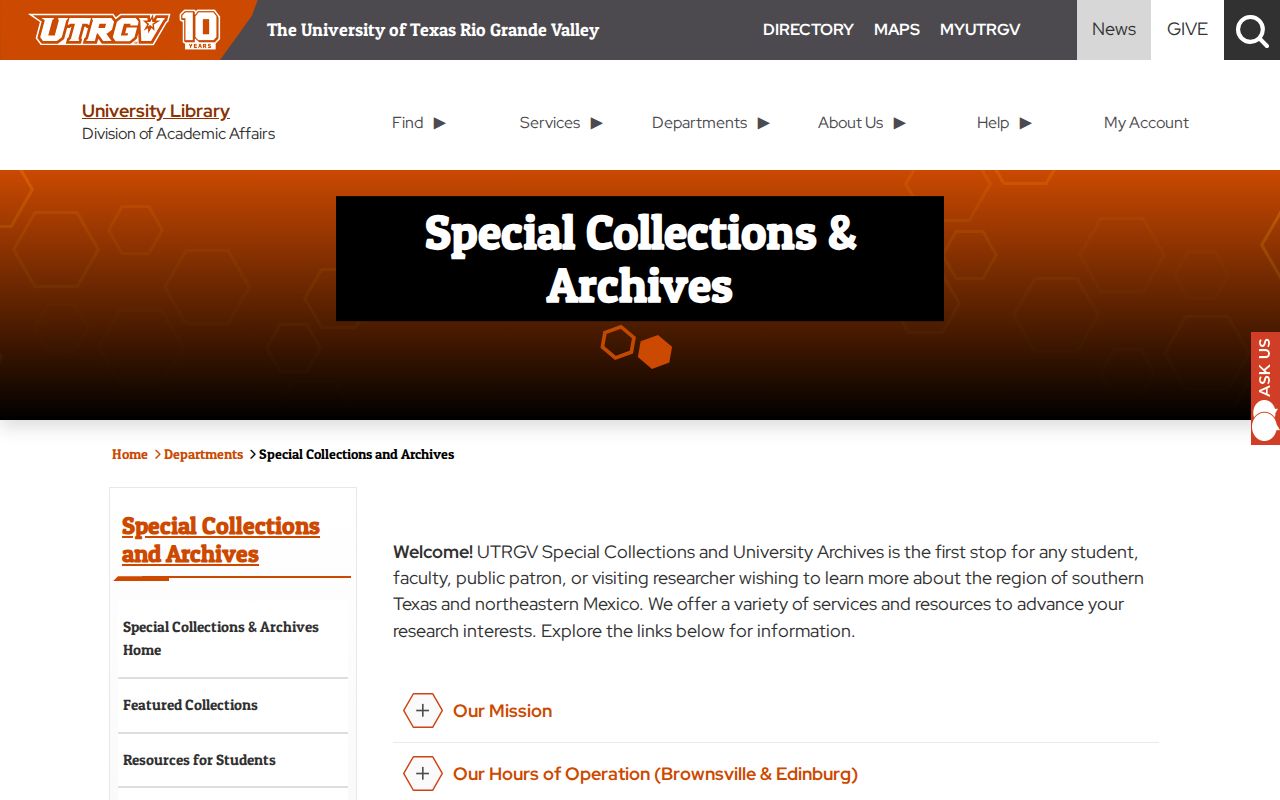
Use the catalog, ArchivesSpace, ScholarWorks, and research guides to identify a collection before arranging an archival visit or an interlibrary-loan request.
Harlingen City Directory Preservation
Harlingen's local-history institutions are working sources, not a single completed digital archive. The Harlingen Public Library at 410 ’76 Drive has local history covering Harlingen, Cameron County, and the Rio Grande Valley, along with non-circulating genealogy materials and an Archives Room with railroad ephemera. Its published collections policy also makes clear that it is not a general repository for every government record. Ask for a locally significant collection or a directory-related lead, rather than assuming a county register is on its shelves.
The Harlingen Arts & Heritage Museum holds local photographs, documents, and printed ephemera. Its 2026 IMLS award funds digital asset management and work to catalog and digitize historical material, but the award does not mean a public name index already exists. The museum is at 2425 Boxwood Street and is open Tuesday through Saturday, 10 a.m. to 4 p.m. Ask about access, identification numbers, and reproduction terms for a particular item.
Harlingen had 71,829 residents in the 2020 Census and a 2025 estimate of 72,467. That scale explains why historical city directories, newspaper issues, library collections, and archives are best used as focused research tools rather than as a comprehensive roll of everyone in the city.
Note: Missing scans, catalog-only records, and imperfect OCR are normal preservation limits and do not establish that a past person or event did not exist.
Harlingen City Directory Voter Facts
City directories and election records answer different historical questions. A directory can place a printed name or address in a dated edition. Texas voter material can confirm registration or participation only within the rules that govern that record. It does not reveal a ballot choice. Texas does not register voters by party affiliation, and primary participation is not permanent party registration.
The official VoteTexas portal uses name, county, date of birth, and ZIP for a registration and polling lookup, with VUID and Texas driver-license alternatives in the documented instructions. Protected voters can have confidential records or suppressed residence addresses. Keep an old city-directory line and a modern voter result separate in the research notes; they represent different dates, custodians, and purposes.
Note: A public record of participation is not a record of a ballot choice and should never be presented as one.
Harlingen City Directory Limits
A Harlingen city directory supports family history, a historic address trail, a local business or institution search, and a dated neighborhood question. It cannot prove a present residence, current telephone number, current property interest, or the complete composition of a household. An entry may use initials, omit a person, list a business, or reflect a pre-publication collection date. A missing name can be a catalog gap, a publisher decision, or an OCR failure.
Use the original page image, state its year, and confirm consequential facts through the custodian that holds the right record. For a recorded property interest, use Cameron County records. For a current parcel trail, use CAD and the clerk. For a historical household, keep the city-directory citation alongside its newspaper, census, or archival companion rather than combining unrelated sources into an unsupported conclusion.